Richmond’s Energov Zoning row keeps adoption history and database maintenance in separate fields. A conditional flag, ordinance path, comment, or default-looking date needs the underlying action because an edited record can still describe an older district. It is not an approval.
Last checked: August 7, 2026.
Begin the adoption-date-versus-edit-date test at Richmond interactive mapping tools, which supplies official parcel-map entry. Cross-check the selected geometry through Richmond Energov Zoning layer, the route used for exact zoning field schema. Before copying Name, verify geodev.richmondgov.com direct city host and layer description says it represents districts defined by the City of Richmond Zoning Ordinance; those markers keep the Energov Zoning record tied to the intended jurisdiction and record period.
AdoptionDate tells Richmond legal history; EditDate tells data maintenance
Richmond's schema separates legal history from data maintenance in a way that demands careful labels. Name stores the district code, including values such as RO-2, B-2, or R-6. Ordinance and OrdinancePath may lead to the adopting action, but sampled rows show that either can be blank. Conditional flags a conditional zoning record; No is a returned value, not proof that variances, special use permits, or other parcel actions are absent. AdoptionDate belongs to the legal-history side, although a value such as 2000-01-01 may be a migration convention requiring confirmation. EditDate belongs to dataset maintenance and must not be reported as adoption. Comment can preserve a note when populated. A reliable row therefore keeps Name, conditional status, ordinance evidence, possible migration date, comments, and edit timestamp separate until the official map and legislative record explain how they relate.
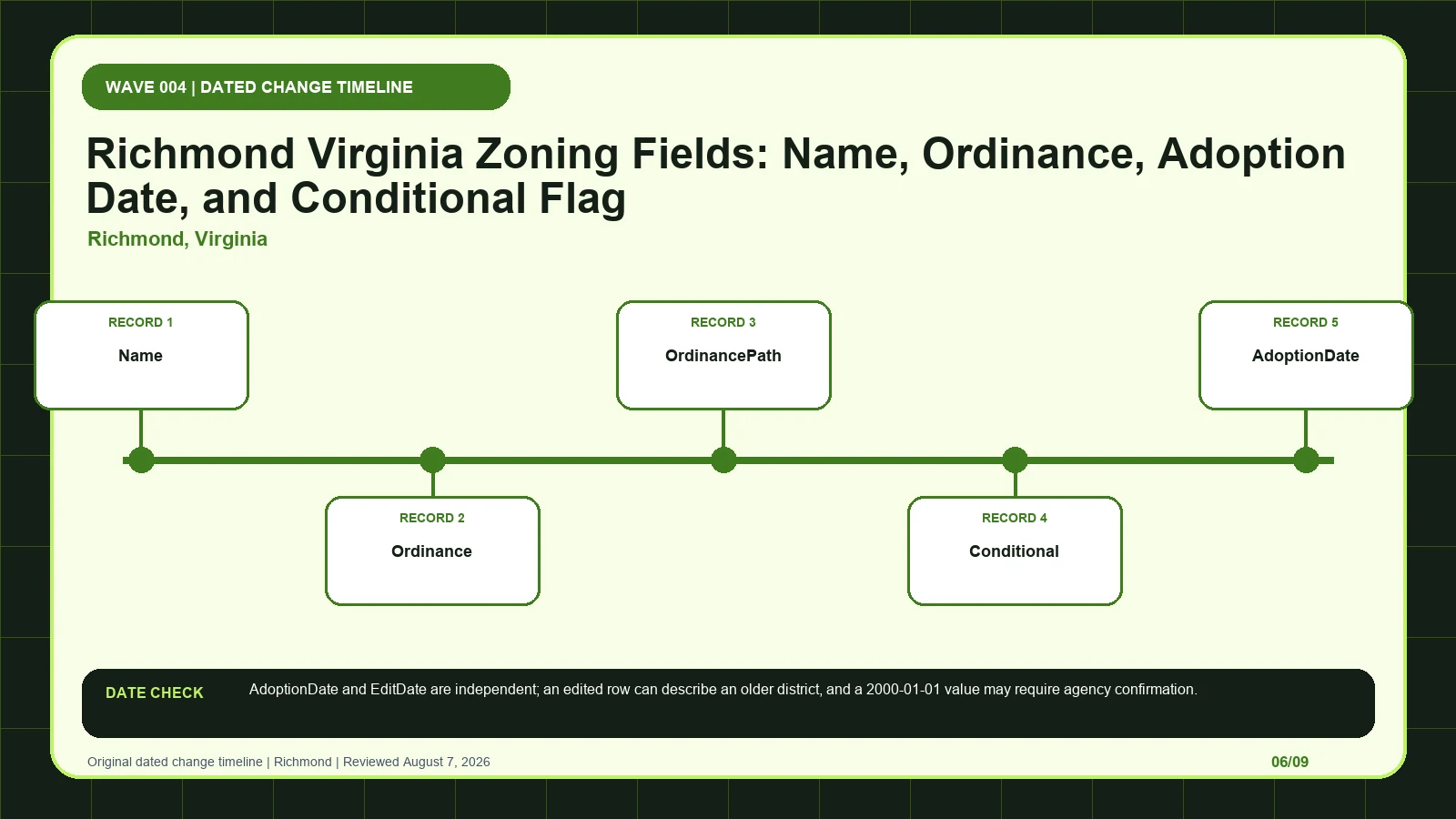
Richmond, Virginia date check: AdoptionDate and EditDate are independent; an edited row can describe an older district, and a 2000-01-01 value may require agency confirmation.
Richmond's 2000-01-01 example needs an explicit migration warning. Repeated first-day-of-year values can be dataset conventions, so the date must be tested as a real action, a migrated default, or another internal rule. EditDate can be much newer because the row was maintained without changing the underlying district's adoption. An empty OrdinancePath may reflect an unlinked record rather than a missing ordinance. The direct City zoning layer cannot assign legal meaning to either date without confirmation. For current reliance, preserve both values, consult the official zoning map and ordinance, and investigate later parcel actions. Conditional No should remain a field report, not a historical clearance. This keeps a current data edit from rewriting the legal timeline.
Name, Ordinance, OrdinancePath, and Conditional must remain linked
The Energov Zoning record table keeps each returned label beside its displayed scope and the separate legal record still waiting to be opened. Its first checkpoint is Name, which may appear as RO-2; B-2; R-6; from there, Open the corresponding Richmond zoning district section. A blank in the adoption-date-versus-edit-date test stays visible so another reader can distinguish an empty official return from an unexamined field.
| Local field, layer, or record | What it does | Displayed value or scope | Next code or record check | Official page |
|---|---|---|---|---|
| Name field | stores the zoning district code | RO-2; B-2; R-6 | Open the corresponding Richmond zoning district section. | Open exact record |
| Ordinance field | can store the adopting ordinance | blank in sampled rows | Search legislative records when the service does not supply it. | Open exact record |
| OrdinancePath field | can store a direct ordinance path | blank in sampled rows | A blank path is not evidence that no ordinance controls. | Open exact record |
| Conditional field | flags a conditional zoning record | No in sampled rows | When yes, retrieve the proffer or condition record; when no, still check other property-specific actions. | Open exact record |
| AdoptionDate field | stores an adoption-date value | 2000-01-01 in sampled rows | Determine whether the value is a real action date, migrated default, or dataset convention. | Open exact record |
| Comment field | can hold a zoning-row note | blank in sampled rows | Preserve comments exactly when populated and verify their source. | Open exact record |
| EditDate field | stores a data-edit timestamp | 2026-07-08 in sampled rows | Do not substitute it for AdoptionDate or ordinance effect. | Open exact record |
A Comment can explain a row without controlling the district
| Returned local record | Record to compare | When to stop | Next decision |
|---|---|---|---|
| Name returns RO-2; B-2; R-6 | Compare with Ordinance, which can store the adopting ordinance | Stop the adoption-date-versus-edit-date test if Ordinance is missing, dated differently, or points to another record. | Continue through the Energov Zoning record: Open the corresponding Richmond zoning district section. Then test whether Ordinance changes that route. |
| Ordinance returns blank in sampled rows | Compare with OrdinancePath, which can store a direct ordinance path | Stop the adoption-date-versus-edit-date test if OrdinancePath is missing, dated differently, or points to another record. | Continue through the Energov Zoning record: Search legislative records when the service does not supply it. Then test whether OrdinancePath changes that route. |
| OrdinancePath returns blank in sampled rows | Compare with Conditional, which flags a conditional zoning record | Stop the adoption-date-versus-edit-date test if Conditional is missing, dated differently, or points to another record. | Continue through the Energov Zoning record: A blank path is not evidence that no ordinance controls. Then test whether Conditional changes that route. |
| Conditional returns No in sampled rows | Compare with AdoptionDate, which stores an adoption-date value | Stop the adoption-date-versus-edit-date test if AdoptionDate is missing, dated differently, or points to another record. | Continue through the Energov Zoning record: When yes, retrieve the proffer or condition record; when no, still check other property-specific actions. Then test whether AdoptionDate changes that route. |
| AdoptionDate returns 2000-01-01 in sampled rows | Compare with Comment, which can hold a zoning-row note | Stop the adoption-date-versus-edit-date test if Comment is missing, dated differently, or points to another record. | Continue through the Energov Zoning record: Determine whether the value is a real action date, migrated default, or dataset convention. Then test whether Comment changes that route. |
| Comment returns blank in sampled rows | Compare with EditDate, which stores a data-edit timestamp | Stop the adoption-date-versus-edit-date test if EditDate is missing, dated differently, or points to another record. | Continue through the Energov Zoning record: Preserve comments exactly when populated and verify their source. Then test whether EditDate changes that route. |
| EditDate returns 2026-07-08 in sampled rows | Compare with Name, which stores the zoning district code | Stop the adoption-date-versus-edit-date test if Name is missing, dated differently, or points to another record. | Continue through the Energov Zoning record: Do not substitute it for AdoptionDate or ordinance effect. Then test whether Name changes that route. |
Trace a conditional Richmond district back to its ordinance
- Open the Energov Zoning record; fix the parcel, boundary, jurisdiction, and official key before reading thematic records.
- Start the adoption-date-versus-edit-date test by copying Name exactly as returned, including RO-2; B-2; R-6.
- Keep Ordinance in a second Energov Zoning record worksheet field because it can store the adopting ordinance.
- Test OrdinancePath independently, then mark its value, service layer, or documented blank in the adoption-date-versus-edit-date test.
- Give Conditional and every later item a separate row; never compress history, plans, and overlays into the Energov Zoning record result.
- Attach the Energov Zoning record lookup time to Name, while preserving this separate currency clue: AdoptionDate and EditDate are independent; an edited row can describe an older district, and a 2000-01-01 value may require agency confirmation.
- If Name and Ordinance conflict, send the adoption-date-versus-edit-date test to Richmond interactive mapping tools and ask whether a migrated date or conditional note reflects legal action.
The Energov Zoning record worksheet is complete only when another reader can reproduce the adoption-date-versus-edit-date test from the same parcel key and official pages. Keep each source's legal role and effective date apart, then record whether a migrated date or conditional note reflects legal action as unresolved instead of selecting the most convenient output. The local currency note remains part of that audit trail: AdoptionDate and EditDate are independent; an edited row can describe an older district, and a 2000-01-01 value may require agency confirmation.
A 2000-01-01 value is a question to resolve, not a fact to smooth over
| Local situation | What went wrong | What to retain | How to resolve it |
|---|---|---|---|
| Scenario 1 | EditDate is reported as the date zoning was adopted. | Preserve OrdinancePath, the selected geometry, and both timestamps from the Energov Zoning record check. | Use Richmond interactive mapping tools to settle whether a migrated date or conditional note reflects legal action; then A blank path is not evidence that no ordinance controls. |
| Scenario 2 | Conditional=No is presented as proof that no proffers, variances, or case-specific records affect the parcel. | Preserve Conditional, the selected geometry, and both timestamps from the Energov Zoning record check. | Use Richmond interactive mapping tools to settle whether a migrated date or conditional note reflects legal action; then When yes, retrieve the proffer or condition record; when no, still check other property-specific actions. |
A Richmond result needs escalation when AdoptionDate and EditDate are confused, when OrdinancePath is blank, or when Conditional No is used to close the file. Start again with Name and the parcel, label each date by its field name, and retain every blank. Search the official ordinance and interactive mapping layers for special use permits or other approvals instead of inferring their absence. If the adoption value appears to be a migration default, send the row and parcel identifier to Richmond Zoning Administration. Ask: 'For this parcel and district Name R-6, does AdoptionDate 2000-01-01 represent an actual zoning action or a data convention, what ordinance established the mapped district, and does Conditional No leave any other property-specific approval to review?' The answer can resolve the provenance of the record without turning a zoning confirmation into permission for a proposed use.
Work a parcel with an older adoption and a newer edit
Hypothetical Richmond exercise: a selected row shows Name R-6, Conditional No, AdoptionDate 2000-01-01, EditDate 2026-07-08, and blank Ordinance, OrdinancePath, and Comment fields. The resulting note should say exactly that the service returned those values. It should not declare that the district was adopted on the edit date, that January 1, 2000 is necessarily a real council action, or that no special approval affects the parcel. The reviewer would open the R-6 ordinance section, search legislative or zoning records for the adoption history, and check the City's parcel mapper for other property-specific layers. This teaching scenario is deliberately hypothetical and does not state that any real Richmond property has this row or that R-6 permits a particular activity. It shows how blanks and two date columns create questions rather than a shortcut to a legal conclusion.
Use Energov, interactive maps, and Zoning Administration in sequence
| Official page | What to check there | Local coverage shown |
|---|---|---|
| Richmond interactive mapping tools | official parcel-map entry | City of Richmond page |
| Richmond Energov Zoning layer | exact zoning field schema | Direct City GIS service describes City Zoning Ordinance districts |
| Richmond zoning administration | official map, ordinance, and confirmation-letter guidance | City department page states every parcel has a designation governed by the official ordinance and map |
How should Name be checked in Richmond, Virginia?
Open the official Name record and capture the value inside the Energov Zoning record. That record shows how Name stores the zoning district code; one displayed form is RO-2; B-2; R-6. Place the copied value in the adoption-date-versus-edit-date test, then follow its separate rule route: Open the corresponding Richmond zoning district section.
How should Ordinance be checked in Richmond, Virginia?
Open the official Ordinance record and capture the value inside the Energov Zoning record. That record shows how Ordinance can store the adopting ordinance; one displayed form is blank in sampled rows. Place the copied value in the adoption-date-versus-edit-date test, then follow its separate rule route: Search legislative records when the service does not supply it.
How should OrdinancePath be checked in Richmond, Virginia?
Open the official OrdinancePath record and capture the value inside the Energov Zoning record. That record shows how OrdinancePath can store a direct ordinance path; one displayed form is blank in sampled rows. Place the copied value in the adoption-date-versus-edit-date test, then follow its separate rule route: A blank path is not evidence that no ordinance controls.
- Selected parcel key, geometry, and responsible jurisdiction
- Every returned value from the local field table
- Page titles, URLs, lookup times, and update clues
- Opened code, plan, case, ordinance, or metadata records
- Unresolved blanks, boundary splits, dates, and competing outputs
- Proposed activity stated in code-relevant facts
- Agency contact, narrow question, reply date, and limits
The Energov Zoning record does not decide title, survey boundaries, private restrictions, vested rights, building-code compliance, utilities, licensing, or permit issuance. Request a written response when the adoption-date-versus-edit-date test leaves competing official results or when substantial reliance is planned. A useful request to Richmond interactive mapping tools identifies the parcel, quotes Name and Ordinance, gives their source dates, and asks whether a migrated date or conditional note reflects legal action.
Use richmond va zoning map by address, zoning code vs zoning map, zoning overlays special districts only where those methods clarify the adoption-date-versus-edit-date test. The Energov Zoning record evidence linked for Name and Ordinance remains the local starting point.
Reviewed August 7, 2026. Recheck the Energov Zoning record, its cited ordinance, and the agency procedure before relying on the saved worksheet.