The June 1, 2023 UDO transition decides how a POLARIS label should be researched across Charlotte and Mecklenburg County. ZonePetition, SPA, RezoneDate, and the approved plan explain why a legacy conditional district did or did not translate into the current system. It is not an approval.
Last checked: August 7, 2026.
Begin the UDO-transition-to-approved-plan trail at Mecklenburg County POLARIS, which supplies parcel identity and property lookup. Cross-check the selected geometry through Charlotte Zoning Ordinance and UDO notice, the route used for current UDO and prior-ordinance boundary. Before copying ZoneDes, verify gis.charlottenc.gov direct city host and Accela/Accela_Dev layer 10 is named Zoning; those markers keep the POLARIS transition record tied to the intended jurisdiction and record period.
ZoneDes is the current label while ZonePetition preserves the action trail
Charlotte's current zoning layer mixes information that cannot be interpreted through one codebook. ZoneDes is the controlling mapped designation, while ZoneClass is only a broad orientation such as INSTITUTIONAL, OFFICE, or GENERAL INDUSTRIAL. ZonePetition and Hyperlink can lead to the petition and approved plan; RezoneDate places the polygon in time; SPA and Overlay report separate flags or values. The key distinction is in ZoneDes: a conventional designation may have translated into the UDO, while INST(CD) or I-2(CD) can preserve a legacy conditional path. The (CD) suffix therefore changes which documents must be opened. A sample SPA value of no or Overlay value of none does not cancel an approved conditional plan. Reconciliation requires the exact ZoneDes, any ZonePetition, the linked plan, RezoneDate, and the June 1, 2023 transition rules.
June 1, 2023 determines which Charlotte code path applies
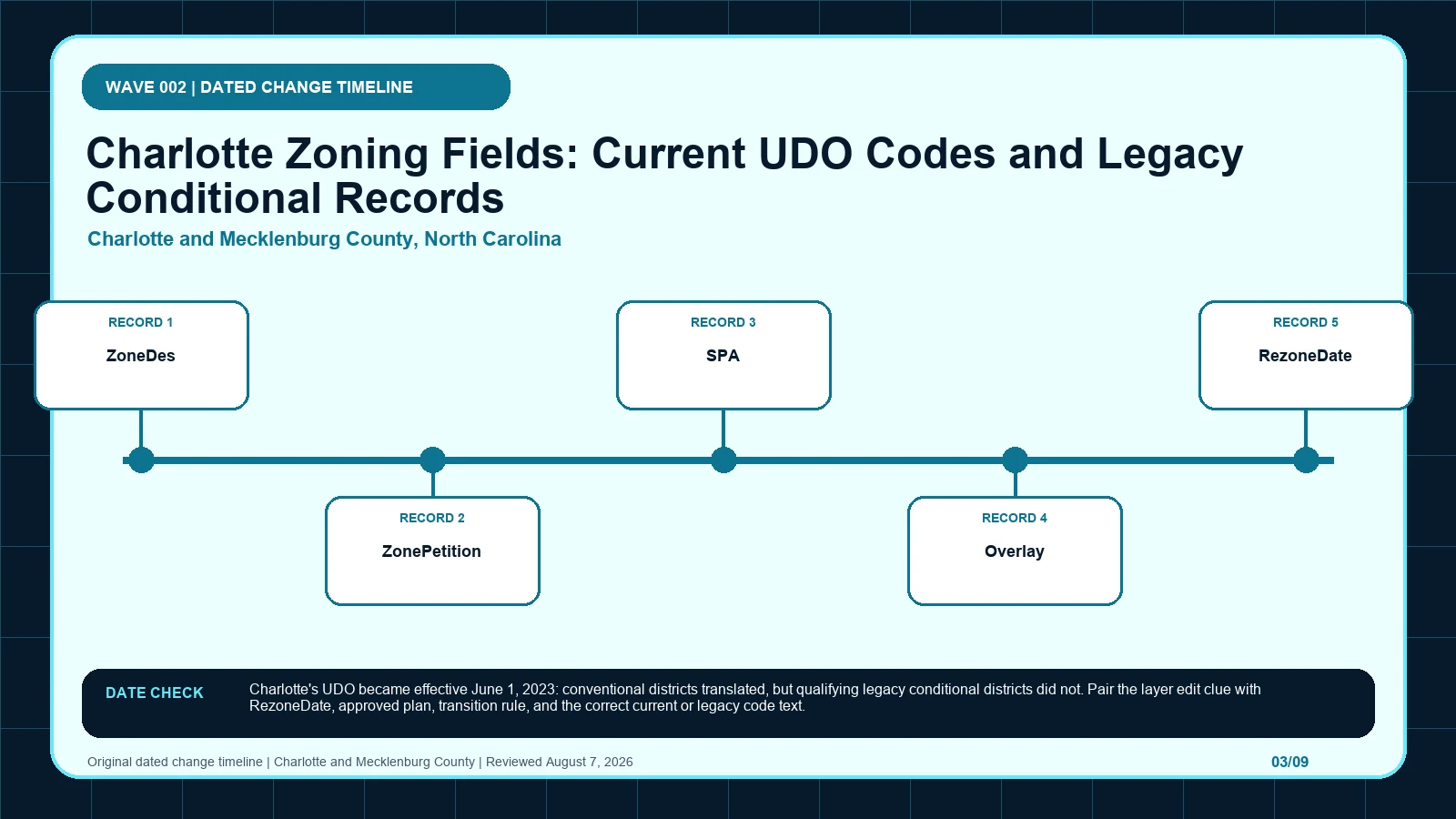
Charlotte and Mecklenburg County, North Carolina date check: Charlotte's UDO became effective June 1, 2023: conventional districts translated, but qualifying legacy conditional districts did not. Pair the layer edit clue with RezoneDate, approved plan, transition rule, and the correct current or legacy code text.
Charlotte's transition rule is unusually important because the UDO became effective June 1, 2023. Conventional districts translated, but qualifying legacy conditional districts did not; they continue to require the approved plan and applicable legacy rules. POLARIS establishes parcel identity, the Accela current Zoning layer supplies ZoneDes and related fields, the City ordinance page marks the current-versus-prior code boundary, and the UDO Transition Fact Sheet explains how conditional and conventional designations diverge. Keep the layer edit clue, RezoneDate, petition action date, approved-plan date, and UDO effective date in different fields. A 2023-06-01 RezoneDate may be significant, but it still must be read with the underlying action. Hyperlink can speed retrieval when populated; a blank link does not prove that no property-specific record exists.
Read SPA, Overlay, RezoneDate, and Hyperlink as different records
The POLARIS transition record table keeps each returned label beside its displayed scope and the separate legal record still waiting to be opened. Its first checkpoint is ZoneDes, which may appear as INST(CD); OFC; I-2(CD); from there, Use the current UDO for translated conventional codes; route (CD) legacy conditional codes to the approved plan and applicable pre-UDO rules. A blank in the UDO-transition-to-approved-plan trail stays visible so another reader can distinguish an empty official return from an unexamined field.
| Local field, layer, or record | What it does | Displayed value or scope | Next code or record check | Official page |
|---|---|---|---|---|
| ZoneDes field | stores the mapped zoning designation | INST(CD); OFC; I-2(CD) | Use the current UDO for translated conventional codes; route (CD) legacy conditional codes to the approved plan and applicable pre-UDO rules. | Open exact record |
| ZonePetition field | links the mapped polygon to a zoning petition | 2004-024; 2023-030; 1977-037 | Retrieve the petition and approved plan when the field is populated. | Open exact record |
| SPA field | indicates whether a site-plan amendment flag is present | sample value: no | A 'no' value does not prove that no conditional plan or other case controls. | Open exact record |
| Overlay field | records the mapped overlay value | sample value: none | Treat 'none' as the returned field value on the lookup date, not a permanent legal warranty. | Open exact record |
| RezoneDate field | records the rezoning date attached to the polygon | 2004-05-17; 2023-06-01; 2023-09-18 | Compare it with the petition action and current UDO effective date. | Open exact record |
| ZoneClass field | groups the mapped district by zoning class | INSTITUTIONAL; OFFICE; GENERAL INDUSTRIAL | Use the class for orientation only; the exact ZoneDes controls the code lookup. | Open exact record |
| Hyperlink field | carries a petition or supporting-record link when available | 2023-030 city rezoning URL | Open the linked petition and verify the final action and plan. | Open exact record |
Follow a legacy conditional district through the UDO transition
In a hypothetical Charlotte lookup, ZoneDes returns INST(CD), ZonePetition returns 2004-024, SPA returns no, and Overlay returns none. The researcher preserves every value exactly. INST(CD) is not automatically translated to a conventional UDO district because the (CD) suffix signals a legacy conditional record. Petition 2004-024 and its approved plan are retrieved, and the applicable pre-UDO provisions are read with that plan. The SPA no value is recorded only as the returned site-plan-amendment flag; it is not converted into a statement that no conditional plan controls. Likewise, Overlay none is dated to the lookup and is not a permanent warranty. RezoneDate is compared with the petition action and the June 1, 2023 UDO effective date. The hypothetical worksheet thus preserves the legacy path instead of forcing INST(CD) into a newer conventional label.
- Open the POLARIS transition record; fix the parcel, boundary, jurisdiction, and official key before reading thematic records.
- Start the UDO-transition-to-approved-plan trail by copying ZoneDes exactly as returned, including INST(CD); OFC; I-2(CD).
- Keep ZonePetition in a second POLARIS transition record worksheet field because it links the mapped polygon to a zoning petition.
- Test SPA independently, then mark its value, service layer, or documented blank in the UDO-transition-to-approved-plan trail.
- Give Overlay and every later item a separate row; never compress history, plans, and overlays into the POLARIS transition record result.
- Attach the POLARIS transition record lookup time to ZoneDes, while preserving this separate currency clue: Charlotte's UDO became effective June 1, 2023: conventional districts translated, but qualifying legacy conditional districts did not. Pair the layer edit clue with RezoneDate, approved plan, transition rule, and the correct current or legacy code text.
- If ZoneDes and ZonePetition conflict, send the UDO-transition-to-approved-plan trail to Mecklenburg County POLARIS and ask whether a legacy conditional district translated or survived.
The POLARIS transition record worksheet is complete only when another reader can reproduce the UDO-transition-to-approved-plan trail from the same parcel key and official pages. Keep each source's legal role and effective date apart, then record whether a legacy conditional district translated or survived as unresolved instead of selecting the most convenient output. The local currency note remains part of that audit trail: Charlotte's UDO became effective June 1, 2023: conventional districts translated, but qualifying legacy conditional districts did not. Pair the layer edit clue with RezoneDate, approved plan, transition rule, and the correct current or legacy code text.
POLARIS and Accela may describe one parcel on different clocks
| Returned local record | Record to compare | When to stop | Next decision |
|---|---|---|---|
| ZoneDes returns INST(CD); OFC; I-2(CD) | Compare with ZonePetition, which links the mapped polygon to a zoning petition | Stop the UDO-transition-to-approved-plan trail if ZonePetition is missing, dated differently, or points to another record. | Continue through the POLARIS transition record: Use the current UDO for translated conventional codes; route (CD) legacy conditional codes to the approved plan and applicable pre-UDO rules. Then test whether ZonePetition changes that route. |
| ZonePetition returns 2004-024; 2023-030; 1977-037 | Compare with SPA, which indicates whether a site-plan amendment flag is present | Stop the UDO-transition-to-approved-plan trail if SPA is missing, dated differently, or points to another record. | Continue through the POLARIS transition record: Retrieve the petition and approved plan when the field is populated. Then test whether SPA changes that route. |
| SPA returns sample value: no | Compare with Overlay, which records the mapped overlay value | Stop the UDO-transition-to-approved-plan trail if Overlay is missing, dated differently, or points to another record. | Continue through the POLARIS transition record: A 'no' value does not prove that no conditional plan or other case controls. Then test whether Overlay changes that route. |
| Overlay returns sample value: none | Compare with RezoneDate, which records the rezoning date attached to the polygon | Stop the UDO-transition-to-approved-plan trail if RezoneDate is missing, dated differently, or points to another record. | Continue through the POLARIS transition record: Treat 'none' as the returned field value on the lookup date, not a permanent legal warranty. Then test whether RezoneDate changes that route. |
| RezoneDate returns 2004-05-17; 2023-06-01; 2023-09-18 | Compare with ZoneClass, which groups the mapped district by zoning class | Stop the UDO-transition-to-approved-plan trail if ZoneClass is missing, dated differently, or points to another record. | Continue through the POLARIS transition record: Compare it with the petition action and current UDO effective date. Then test whether ZoneClass changes that route. |
| ZoneClass returns INSTITUTIONAL; OFFICE; GENERAL INDUSTRIAL | Compare with Hyperlink, which carries a petition or supporting-record link when available | Stop the UDO-transition-to-approved-plan trail if Hyperlink is missing, dated differently, or points to another record. | Continue through the POLARIS transition record: Use the class for orientation only; the exact ZoneDes controls the code lookup. Then test whether Hyperlink changes that route. |
| Hyperlink returns 2023-030 city rezoning URL | Compare with ZoneDes, which stores the mapped zoning designation | Stop the UDO-transition-to-approved-plan trail if ZoneDes is missing, dated differently, or points to another record. | Continue through the POLARIS transition record: Open the linked petition and verify the final action and plan. Then test whether ZoneDes changes that route. |
Do not let the newest-looking row erase an approved plan
| Local situation | What went wrong | What to retain | How to resolve it |
|---|---|---|---|
| Scenario 1 | A (CD) suffix is dropped or automatically translated, so the approved conditional plan and applicable legacy rules are never reviewed. | Preserve SPA, the selected geometry, and both timestamps from the POLARIS transition record check. | Use Mecklenburg County POLARIS to settle whether a legacy conditional district translated or survived; then A 'no' value does not prove that no conditional plan or other case controls. |
| Scenario 2 | A conventional pre-UDO code is applied without checking its UDO translation, or a blank Hyperlink/Overlay value is treated as proof that no property-specific record exists. | Preserve Overlay, the selected geometry, and both timestamps from the POLARIS transition record check. | Use Mecklenburg County POLARIS to settle whether a legacy conditional district translated or survived; then Treat 'none' as the returned field value on the lookup date, not a permanent legal warranty. |
If a Charlotte worksheet dropped (CD) from ZoneDes, restore the exact value first and stop any UDO-only analysis. Retrieve ZonePetition, Hyperlink, approved plan, and RezoneDate, then identify the applicable pre-UDO text under the transition guidance. If a conventional pre-UDO designation was analyzed under the old ordinance without checking its UDO translation, document both labels and move the current district analysis to the UDO. A blank Hyperlink, SPA no, or Overlay none remains a dated field result rather than proof of absence. The focused agency question should quote the exact ZoneDes and petition: Does this parcel remain governed by the approved legacy conditional plan, or did its conventional designation translate on June 1, 2023, and which code text now controls? Attach the POLARIS parcel, RezoneDate, and returned flags so the answer addresses the correct polygon.
Open the petition, transition fact sheet, and current UDO in that order
| Official page | What to check there | Local coverage shown |
|---|---|---|
| Mecklenburg County POLARIS | parcel identity and property lookup | Official Mecklenburg County parcel viewer |
| Charlotte Zoning Ordinance and UDO notice | current UDO and prior-ordinance boundary | City page states the UDO replaced the prior ordinance in 2023 |
| Charlotte Accela current Zoning layer | current zoning field schema | Direct City GIS layer named Zoning |
| Charlotte UDO Transition Fact Sheet | conditional and conventional zoning transition rules | City fact sheet states conventional districts translate while legacy conditional districts do not |
How should ZoneDes be checked in Charlotte and Mecklenburg County, North Carolina?
Open the official ZoneDes record and capture the value inside the POLARIS transition record. That record shows how ZoneDes stores the mapped zoning designation; one displayed form is INST(CD); OFC; I-2(CD). Place the copied value in the UDO-transition-to-approved-plan trail, then follow its separate rule route: Use the current UDO for translated conventional codes; route (CD) legacy conditional codes to the approved plan and applicable pre-UDO rules.
How should ZonePetition be checked in Charlotte and Mecklenburg County, North Carolina?
Open the official ZonePetition record and capture the value inside the POLARIS transition record. That record shows how ZonePetition links the mapped polygon to a zoning petition; one displayed form is 2004-024; 2023-030; 1977-037. Place the copied value in the UDO-transition-to-approved-plan trail, then follow its separate rule route: Retrieve the petition and approved plan when the field is populated.
How should SPA be checked in Charlotte and Mecklenburg County, North Carolina?
Open the official SPA record and capture the value inside the POLARIS transition record. That record shows how SPA indicates whether a site-plan amendment flag is present; one displayed form is sample value: no. Place the copied value in the UDO-transition-to-approved-plan trail, then follow its separate rule route: A 'no' value does not prove that no conditional plan or other case controls.
The narrow question that resolves a Charlotte transition conflict
- Selected parcel key, geometry, and responsible jurisdiction
- Every returned value from the local field table
- Page titles, URLs, lookup times, and update clues
- Opened code, plan, case, ordinance, or metadata records
- Unresolved blanks, boundary splits, dates, and competing outputs
- Proposed activity stated in code-relevant facts
- Agency contact, narrow question, reply date, and limits
The POLARIS transition record does not decide title, survey boundaries, private restrictions, vested rights, building-code compliance, utilities, licensing, or permit issuance. Request a written response when the UDO-transition-to-approved-plan trail leaves competing official results or when substantial reliance is planned. A useful request to Mecklenburg County POLARIS identifies the parcel, quotes ZoneDes and ZonePetition, gives their source dates, and asks whether a legacy conditional district translated or survived.
Use charlotte mecklenburg zoning map by address, zoning code vs zoning map, zoning overlays special districts only where those methods clarify the UDO-transition-to-approved-plan trail. The POLARIS transition record evidence linked for ZoneDes and ZonePetition remains the local starting point.
Reviewed August 7, 2026. Recheck the POLARIS transition record, its cited ordinance, and the agency procedure before relying on the saved worksheet.