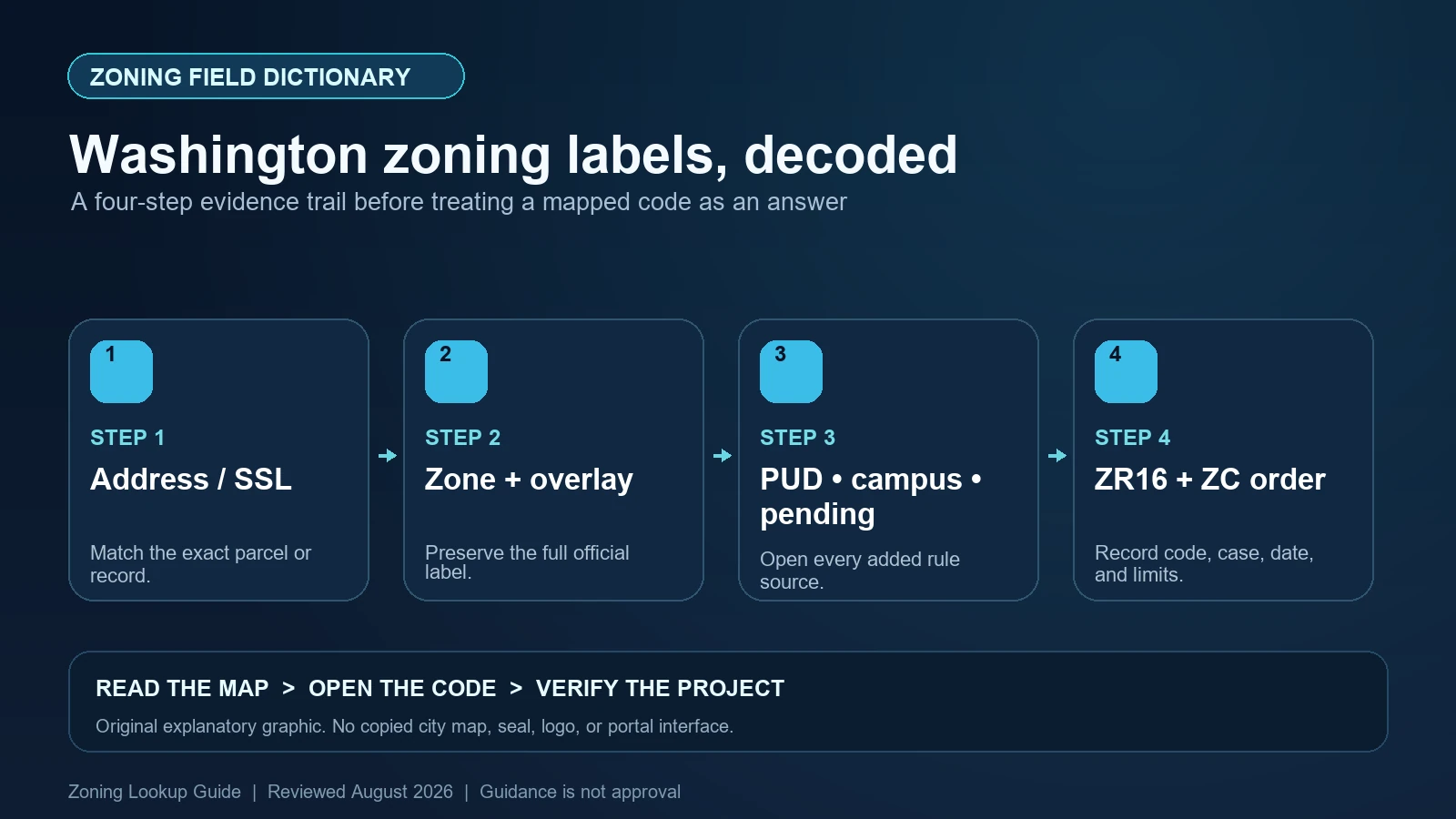
A Washington, DC zoning result begins with property identity: address plus Square, Suffix, and Lot (SSL). Save the complete zone label that touches that lot, including any slash overlay notation. Then inspect Active PUD, Pending PUD, Pending Zone, Campus Plan, Inclusionary Zoning Plus, and Zoning Commission case information as separate layers. A pending zone or PUD application is not the current zone, and the most recent PUD case shown is not necessarily the complete history of that property.
Last checked: August 7, 2026.
The DC Official Zoning Map supports searches by address, SSL, parcel, Zoning Commission case, or PUD. The Office of Zoning says the interactive map displays updated zoning information and allows layers to be turned on and off. Use it to route research into the Zoning Regulations of 2016 (ZR16) and case records. For a certified zoning statement required by law or a transaction, contact the Office of Zoning; an interactive map printout is not that certification.
Use SSL to lock the legal lot before reading the zone
DC’s tutorial describes an SSL search using a four-digit square and a lot, with a suffix where applicable. Search the address first, then record and repeat the search with the complete SSL. A street address can refer to a building entrance, multiple lots, a condominium, or land near a square boundary. The SSL makes the property record reproducible and is the better key for case research.
Select the lot polygon and inspect all zoning polygons that intersect the project area. If a project spans several lots or a zone boundary crosses a lot, create separate rows. Do not decide which district controls a strip of land by the address marker. Save the map extract and seek an Office of Zoning determination or certification appropriate to the reliance when geometry is disputed.
Preserve the full ZR16 zone and overlay notation
ZR16 organizes zone families in subtitles for Residential, Residential Flat, Residential Apartment, Mixed-Use, Neighborhood Mixed-Use, Downtown, Production Distribution and Repair, and special-purpose areas, along with area-specific subtitles. Labels such as R-3, RF-1, RA-2, MU-4, D-6, or PDR identify different code paths. Copy the complete value and use the current subtitle rather than an unofficial abbreviation list.
The Office of Zoning’s ZR16 structure page explains that a 2023 reorganization reintroduced a base-zone-plus-overlay naming convention for many zones. A value such as R-3/GT or RF-1/DC therefore must be preserved through the slash and routed to both the base and named overlay provisions. Do not call every trailing letter a subzone, or remove it because a pre-2023 chart used another designation.
| Map item | What to preserve | What it does not establish |
|---|---|---|
| Address | The searched street location and selected result | The complete legal lot identity |
| Square / Suffix / Lot | The reproducible DC real-property key | That one zoning polygon covers the entire project |
| Zone | The full current label and boundary | Permission for the exact use or building |
| Slash overlay notation | Base zone plus the named overlay code | A decorative map suffix with no additional text |
| ZC case / PUD | Case number, order, plans, conditions, and mapped extent | That the latest case displayed is the full history |
| Pending Zone / Pending PUD | Application, requested action, status, and hearings | A current or approved designation |
Use the 2023 conversion table when older and current labels differ
DC has records under the 1958 regulations, the original 2016 designations, and the reorganized ZR16 names effective August 25, 2023. The official Zone Conversion Table crosswalks those systems. Use it when a deed, order, appraisal, or older plan cites a designation different from today’s map. Record both the historical label and current mapped label with the relevant dates.
A conversion table is a naming and research tool, not proof that every old approval disappeared or every standard remained identical. A PUD order, variance, special exception, campus plan, or map amendment can remain important to the property. Open the underlying order and later modifications. When the current label includes a reintroduced overlay, read the current overlay provisions instead of relying solely on the older zone description.
Active PUD and the most recent case field require document review
An Active PUD layer tells the reader that approved planned-unit-development controls may affect the site. Save the PUD name, Zoning Commission case number, lot coverage, orders, approved plans, conditions, time extensions, modifications, and any later map action. The official map warns that the case name and number shown for a PUD reflect the most recent associated case data, so use that result as the beginning of the case chain rather than its entire history.
Compare the approved PUD boundary with the project’s SSLs and plans. A nearby PUD label may not cover the selected lot, and an order can authorize a defined building and use rather than a freely transferable development envelope. Check whether the approval remains valid and whether a modification is needed. The current zone and PUD controls should remain in separate evidence rows even when both affect the same proposal.
Pending Zone, Pending PUD, and map amendment are status records
The Office of Zoning defines a map amendment as a request to change an area from one zone to another. Its map-amendment page routes users to Subtitle X, Chapter 5, application instructions, IZIS, and recently filed cases. A requested zone remains a proposal until the Zoning Commission process, final order or rulemaking, effectiveness, and map update establish otherwise.
Keep Pending Zone and Pending PUD layers apart from current zone and Active PUD. Record the requested action, applicant, case number, setdown status, notices, hearings, order, reconsideration or appeal, and effective date. Boundaries or terms can change during the process. If a transaction depends on the outcome, describe the uncertainty rather than publishing the requested designation as inevitable.
| Layer or label | Document path | Status wording to use |
|---|---|---|
| Current zone | Official map plus current ZR16 subtitle and overlay text | Mapped current zone as of the checked date |
| Active PUD | ZC orders, approved plans, conditions, and modifications | Approved PUD record; scope and validity still require review |
| Pending PUD | IZIS case, filings, hearings, and final orders when issued | Pending request, not current approval |
| Pending Zone | Map-amendment case or rulemaking record | Proposed map change, not current zone |
| Campus Plan | Approved plan, term, further-processing cases, and lot coverage | Institutional planning approval with defined scope |
| IZ+ layer | Subtitle X § 502 and current mapped area | An inclusionary-zoning set-aside context, not a base-zone replacement |
Campus plans, IZ+, and historic views answer additional questions
Campus Plan and Inclusionary Zoning Plus layers sit beside zone and PUD information because they affect specialized research. A campus plan has an approved term, boundaries, conditions, and later further-processing applications. IZ+ identifies areas subject to increased affordable-housing set-asides under the cited ZR16 provision. Neither should be merged into the base-zone field or assumed to apply to every project in the surrounding neighborhood.
The Office of Zoning also provides a Historic Zoning Viewer with selected years. That viewer is useful for tracing past designations but does not replace the current Official Zoning Map. Save the historical year and purpose of the comparison. If a use or building relies on nonconforming history, a historic map is one piece of evidence; permits, certificates, orders, and lawful-continuity facts may also be required.
Read the correct ZR16 subtitles for use, form, and procedure
Describe the proposed use and construction in detail, then open the subtitle for the mapped base zone, the subtitle for any overlay, and the common general, parking, and procedural subtitles referenced by them. Check permitted and special-exception uses, matter-of-right limits, height, lot occupancy, yards, floor-area ratio, penthouses, parking, inclusionary zoning, and any design-review or Board process relevant to the facts.
Do not infer permission from an existing building, tax classification, or nearby operation. The site may be lawful nonconforming, subject to an old Board order, covered by a PUD, or operating under a certificate with conditions. Match each approval to the SSL, use, plans, and current proposal. An interactive scenario or 3D visualization is illustrative and does not replace the regulations or formal review.
Stop when identity, status, or code versions do not align
Escalate if address and SSL results differ, a zone boundary crosses the lot, a 1958 or pre-reorganization label appears without conversion research, the map shows only the most recent PUD case, or pending and current layers conflict. Save the exact map report, date, case results, orders, and code versions. The Office of Zoning can provide the appropriate certification route when a legal requirement demands one.
Do not use ‘DC approved’ as a shorthand for a colored polygon. State whether the source is the current map, a pending case, an effective order, an approved campus plan, or an interpretive summary. That precision gives a purchaser, tenant, designer, or neighbor a usable next step without overstating the guide’s authority.
- Stop if the lookup records an address but not the complete Square-Suffix-Lot identity.
- Stop if a slash overlay has been dropped or decoded with a pre-2023 chart without checking the current ZR16 organization.
- Stop if the most recent PUD case displayed by the map is being treated as the property’s complete approval history.
- Stop if Pending Zone, Pending PUD, or a map-amendment request is being stated as current law.
Create a DC lot, layer, and case ledger
Save the address, SSL, selected lot, complete zone and overlay notation, applicable ZR16 subtitles, current and historical labels, Active and Pending PUDs, Pending Zone, campus plan, IZ+ status, ZC and BZA cases, orders, plans, effective dates, and proposal facts. Label every row as current map, adopted order, pending record, historical evidence, or interpretation.
Use the site’s Washington DC address and SSL guide for the initial map search, the code-versus-map guide for ZR16 routing, and the overlay and special-case worksheet to keep PUD and pending layers separate. DCOZ maps, regulations, and orders remain controlling.
Official Washington records used for this field dictionary
The working evidence set for this Washington field dictionary is the Washington official interactive zoning map (1), Washington official interactive zoning map (2), Washington official planning and zoning guidance (3), Washington official planning and zoning guidance (4), and Washington official planning and zoning guidance (5). Each source answers a different part of the lookup. The Washington map locates the record, the municipal layer or dataset exposes fields, and the applicable code or agency guidance controls interpretation. Save each Washington URL and the date checked instead of treating a search-result snippet as the source.
Questions to resolve before relying on the zoning label
Why is SSL important in a DC zoning search?
Square, Suffix, and Lot provides the reproducible property key. It reduces ambiguity from entrances, multiple lots, and similar addresses and connects the map to case records.
Does a slash in a DC zone label identify an overlay?
Under the reorganized ZR16 naming convention, many labels use base-zone-plus-overlay notation. Preserve the complete label and open both current provisions rather than dropping the suffix.
Is the PUD case shown on the map the full history?
Not necessarily. DCOZ notes that the displayed PUD case name and number reflect the most recent associated case data. Review the case chain, orders, plans, conditions, and modifications.
When does a pending DC zone become current?
Only after the applicable Zoning Commission process produces an effective legal action and the current official source confirms the change. A filing or pending layer is not enough.
The DC Official Zoning Map, ZR16 organization, PUD and campus-plan cases, map amendments, and summary map extracts can update on different schedules. Reopen the live SSL result, current subtitles, and orders before reliance. This guide was reviewed August 7, 2026.