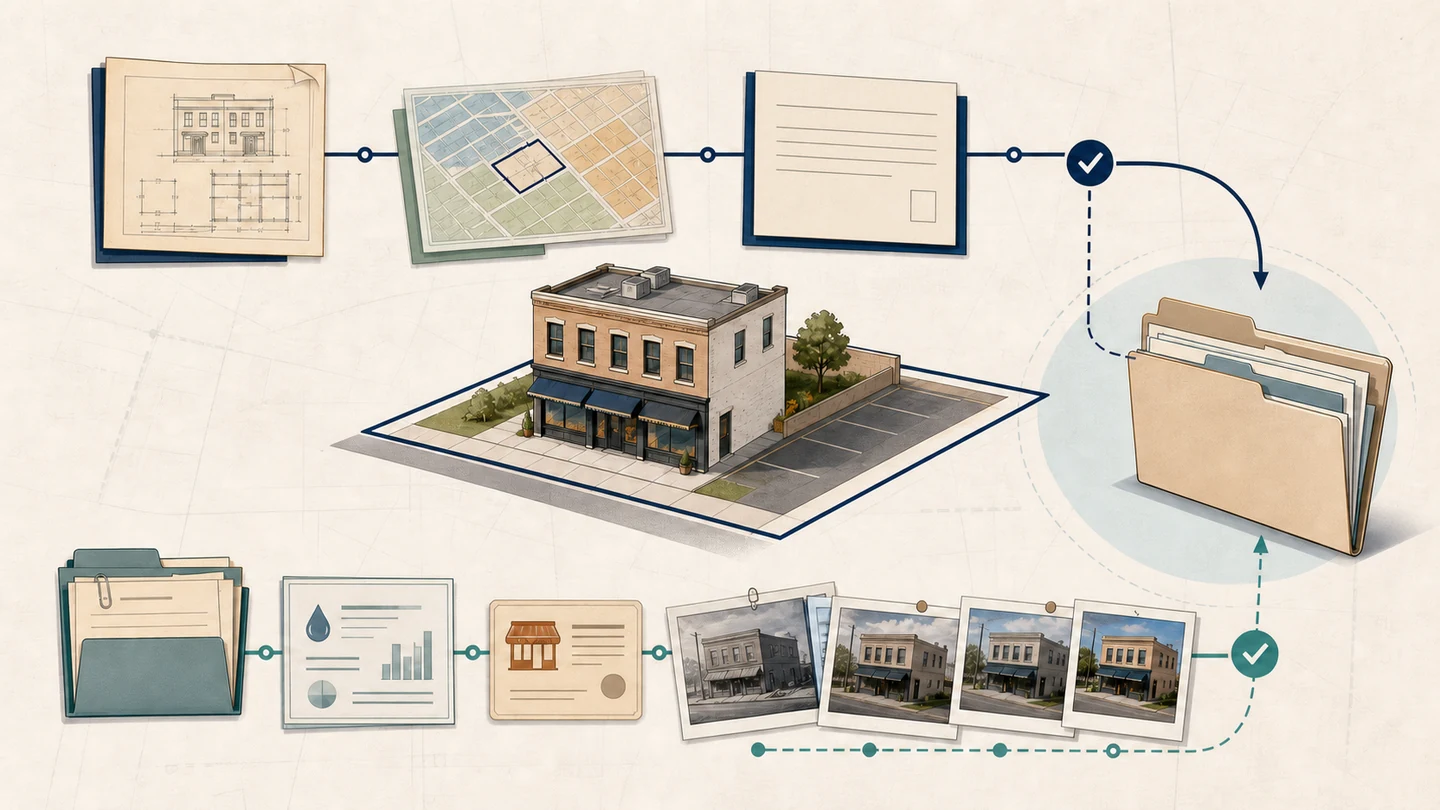
A use that current zoning does not allow may still be lawful if it was legally established under the rules in effect at the time and preserved under the local nonconforming-use rules. Do not rely on age, tax records, a business license, or the word “grandfathered” by itself. Build a dated record showing both lawful establishment and continued use, then ask the local zoning authority for the determination or confirmation its code requires.
Start with two separate questions
The first question is whether the exact use was lawful when it began. The second is whether the use continued in a way that preserved any nonconforming rights. Portland’s official nonconforming review guidance, for example, requires an applicant to show that the situation was allowed when established and maintained over time. Kansas City’s Certificate of Legal Nonconformance bulletin likewise warns that a current use is not automatically eligible merely because it exists.
Those examples illustrate a common research pattern, not a nationwide rule. Zoning is local. The controlling definition, evidence standard, discontinuance period, transfer rule, expansion limit, and review process come from the jurisdiction responsible for the property. A record package can support a request, but only the proper local process can decide the site’s legal status.
Identify what is actually nonconforming
A property can fail to match current rules in more than one way. The use may be nonconforming because the activity is no longer permitted. A structure may be noncomplying because its height, setback, lot coverage, parking, or other physical condition does not meet a current standard. A lot, density, sign, or site development can have a separate status. Do not treat proof for one condition as proof for all of them.
| Question | Record trail to start with | What it does not settle |
|---|---|---|
| Was the use lawful when it began? | Permit, certificate of occupancy, land-use approval, old code and zoning map | Whether the use was maintained without a disqualifying break |
| Did the same use continue? | Dated licenses, leases, directories, utility or tax records, photos, inspections | Whether local rules allow expansion or a different use |
| Is the building itself legal? | Approved plans, building permits, inspection records, occupancy documents | Whether the business activity is permitted by zoning |
| Can the use continue today? | Local confirmation, determination, certificate, or permit | Compliance with every building, fire, health, licensing, or private rule |
Begin with the current parcel and zoning result using the zoning lookup by address guide. Then write one precise description of the questioned use: what activity occurred, where on the site, in how much floor or outdoor area, during which dates, and under which operator. A broad label such as “commercial” is rarely specific enough to match old permits and current use categories.
Build the timeline before collecting documents
A useful timeline starts before the claimed use began and continues through the present. Identify when the use first appeared, what zoning and code applied on that date, when a rezoning or text amendment made it nonconforming, and whether later permits, closures, vacancies, damage, changes, or expansions affected it. The zoning code versus zoning map guide helps separate a map label from the ordinance text and effective date that control the historical question.
- Confirm the parcel, legal description, and any address changes.
- Describe the exact historical use and the exact current use.
- Find the rule and zoning map in effect when the use began.
- Identify the ordinance or map change that created the nonconformity.
- Mark every possible interruption, vacancy, closure, disaster, or change of operator.
- Record later permits, variances, conditional approvals, enforcement cases, and written determinations.
Do not let a recent database overwrite the historical question. A current online map usually shows current zoning, not necessarily the zoning in effect decades ago. Ask the planning records office for archived zoning maps, ordinance histories, case files, and the effective date of the change. The planning department search guide explains when an online result should be followed by a records request or formal letter.
Prove that the use was lawful when established
The strongest evidence normally comes from the government action that authorized the use: an issued building or use permit, certificate of occupancy, approved land-use review, variance or zoning-change decision, special-use approval, or another dated decision. Pair that record with the zoning code and map in effect on the approval date. A permit application, expired proposal, tax classification, or unsigned plan may show intent or history without proving approval.
Portland’s current Documenting a Nonconforming Situation application lists building, land-use, and development permits plus zoning codes or maps as standard evidence that a situation was allowed when established. This is a useful model for organizing records, but another city may require different documents, a different form, or a hearing.
Occupancy records can be especially important, but their meaning is local. The New York City Certificate of Occupancy guidance says a CO states the legal use or permitted occupancy of a building. It also explains that certain older buildings may instead need a Letter of No Objection. That NYC route should not be copied in a different jurisdiction; use it as a reminder to ask what local document identifies legal use when no modern CO exists.
Show that the same use was maintained over time
Lawful establishment is only half of the file. Many local codes can terminate or limit nonconforming rights after discontinuance, abandonment, a change to another use, destruction, or an unauthorized expansion. The exact trigger and time period vary, so quote the local section rather than importing a deadline from another city.
Build a dated chain that identifies the same use at the same property. Portland’s application lists utility bills, income-tax records, business licenses, directories, dated advertisements, permits, insurance policies, leases, aerial photographs, insurance maps, and government inventories as examples of continuity evidence. It asks for documentation in increments of at least three years, but that interval is Portland’s process, not a universal safe harbor.
A license proves that a licensing agency issued a record; it does not necessarily prove zoning approval. A tax assessment may describe a building without showing how every space was used. Utility service may show occupancy without identifying the activity. Treat these documents as pieces in a chain and tie each piece to the property, operator, space, and use claimed.
Match every record to the property and the use
Old addresses, renumbered streets, parcel splits, lot mergers, suite changes, and corporate names can make unrelated records look connected. Create a crosswalk with current and former addresses, parcel numbers, legal descriptions, owner names, tenant names, and floor or site locations. When a document covers only one unit or part of a lot, do not apply it to the whole property.
The activity must also match. A grocery, restaurant, bar, warehouse, repair shop, office, and manufacturing use may occupy the same building at different times but fall into different local use categories. Seattle’s official establishing-use guidance describes evidence such as business or license records, tax assessments, utilities, statements, photographs, and census reports, while still routing the owner through a permit process to establish the use for the record.
When the permit history is missing or contradictory
A blank online portal does not prove that no approval ever existed, and a long-running use does not prove that approval did exist. Ask where archived permits, microfilm, zoning maps, board decisions, inspection cards, certificates, and annexation records are stored. Search by parcel, legal description, former address, owner, business name, and case number. Keep the records office’s written response if a search finds nothing.
If standard records cannot establish the history, ask whether the jurisdiction offers a formal nonconforming-status review, certificate, zoning confirmation letter, or permit to establish use for the record. Portland distinguishes standard-evidence confirmation from a legal nonconforming-status review when nonstandard evidence must be evaluated. Kansas City uses a Certificate of Legal Nonconformance process. Seattle has an establishing-use permit route. The correct name and burden of proof depend on the site.
Contradictions should be disclosed, not smoothed over. If a tax record says four units while the last permit shows two, or a license predates the zoning approval, list both records and ask the reviewing official what they establish. Check the zoning violations and code-enforcement guide for unresolved cases, but remember that the absence of a violation is not an affirmative legal-use determination.
Get the local conclusion in writing
Before relying on nonconforming status for a purchase, lease, loan, renovation, expansion, or business opening, ask what written output the jurisdiction provides. State the exact question: current legal use, number of units, floor area, outdoor activity, parking arrangement, or right to resume after a closure. Submit the property crosswalk, timeline, source documents, and code provisions in an indexed file so the reviewer can see what each exhibit is meant to prove.
Read the scope of the response. A zoning confirmation may not decide building-code compliance, fire occupancy, licensing, health approval, title, easements, or private covenants. A certificate may apply only to the use and area documented. A decision may include conditions, limits on expansion, or an appeal deadline. Save the final signed document and all exhibits together.
What this research cannot prove
This guide cannot determine that a use is legal, vested, transferable, expandable, or safe to resume. It does not provide legal advice and cannot replace the local code, official review, land-use counsel, a survey, title work, or building and fire approvals. Nonconforming-use disputes can affect property value and enforcement exposure, so obtain qualified local help when the record is incomplete, the agency disagrees, or money depends on the outcome.
Questions owners and buyers ask
Does paying property tax prove a legal nonconforming use?
Usually not by itself. A tax record can support the history of a property, but it may not show that zoning authorized the exact use or that the use continued without a disqualifying change.
Does a business license prove zoning approval?
Not necessarily. A licensing agency may issue or renew a license based on criteria different from zoning. Pair the license with the approval and code records required by the local zoning authority.
Can a buyer inherit nonconforming-use rights?
Possibly, but the answer depends on local law, the property history, any discontinuance, and the scope of the documented right. Ask the jurisdiction to confirm the status and any transfer conditions in writing.
Can the use be expanded or changed to another use?
Do not assume so. Many codes restrict expansion, relocation, rebuilding, or substitution of a nonconforming use. Review the exact local provisions and obtain any required approval before changing the site or operation.
What if the city has no old permit on file?
Search archived systems and alternate identifiers, document the records search, and ask whether the jurisdiction has a formal process for evaluating secondary or nonstandard evidence. Missing records do not automatically prove either legality or illegality.
Official source pages and forms were checked July 28, 2026. Local rules and forms can change.