Changing zoning on a property usually requires a local rezoning or map-amendment application; a variance is narrower relief from a rule and does not rewrite the zoning map. Start with the parcel and current district, identify the approval path, and then track the application through hearing, decision, conditions, appeal, and effective date. Only the final effective record should be treated as the outcome.
Choose the process that matches the problem
Changing the zoning map is only one possible path. First identify whether the obstacle is a data error, an unclear rule, a use that needs discretionary approval, a dimensional hardship, or a district that does not allow the proposal. The local names and filing standards vary, so use this table to ask the planning office for the right record rather than assuming every request is a variance.
| What is blocking the project | Record or process to ask for |
|---|---|
| The map highlights the wrong parcel or shows a data mismatch | Parcel or map-data correction; this is not automatically a rezoning |
| The code or prior approval is unclear | Written zoning verification, interpretation, or determination |
| The use is allowed only after project review | Conditional use, special use, or the local equivalent |
| A site-specific hardship prevents compliance with a standard | Variance or adjustment under the local findings |
| The current district does not allow the proposed use or form | Rezoning, map amendment, or text amendment |
| A staff, board, or commission decision is disputed | Administrative or judicial appeal filed before the stated deadline |
A filing receipt proves only that an application entered the process. Do not rely on a proposed map, staff recommendation, hearing result, or unsigned notice as the final outcome; open the signed decision, conditions, effective date, and any appeal record.
Zoning records are local. The agency name and legal vocabulary change by city, county, state, province, or council. The examples below show how public U.S. systems separate a map change from property-specific relief; use the authority that controls the actual parcel.
Decide which record you actually need
| Question | Record to open | What it can answer |
|---|---|---|
| What rules apply now? | Current zoning map and ordinance | Base district, overlays, and current rule text |
| Was the map or zoning text changed? | Rezoning or zoning-change case | Proposed action, public review, adoption, and effective date |
| Was relief granted for one property or proposal? | Variance or zoning-appeal case | Requested deviation, decision, conditions, and expiration |
| Can work begin? | Permit and approval record | Whether a separate permit was issued and remains active |
A zoning change, often called a rezoning, can amend a zoning map or rule through the local legislative process. A variance usually leaves the underlying district in place and grants limited relief for a specific property or proposal under local law. Those are general distinctions, not universal definitions, so confirm the terms in the controlling ordinance.
Start with the parcel and one case identifier
Use a parcel number, lot and block, assessor ID, or cadastral reference when the portal accepts one. Street addresses can be reformatted, duplicated, or placed near a district boundary. If a hearing notice, deed file, permit, or planning letter lists a case number, search that identifier before trying keywords.
- Confirm the city, county, borough, or council that controls land use.
- Match the parcel on the official map rather than a nearby address point.
- Copy the case number exactly, including prefixes, year, and action codes.
- Keep the proposed use or dimensional relief beside the identifier.
If the responsible authority is unclear in the United States, use the USA.gov local-government directory as a routing aid, then move to the planning, zoning, clerk, or appeals site for that jurisdiction.
A current zoning map is not the property history
The map answers what is mapped now. It may not display an older variance, a site-specific condition, a pending rezoning, a nonconforming-use determination, or the document that made a change effective. Use the zoning lookup by address guide to establish the parcel and current district, then continue into the case records. If the current map conflicts with a long-established activity, use the legal nonconforming use records guide to assemble the dated approval and continuity evidence before asking the local authority for a determination.
When the map and a case document disagree, compare their dates and scope. A decision can apply only to a described use, plan set, building area, owner obligation, or period. A later amendment, lapse, appeal, or court order can also change what the earlier document means today.
Search the planning case or zoning appeals docket
- Open the official planning or zoning-appeals search for the controlling jurisdiction.
- Search the exact case number. If it fails, try the parcel ID, street address, project name, or action type.
- Confirm that the parcel and requested action match the question you are researching.
- Open the docket, hearing entries, staff material, decision, and later amendments rather than stopping at the result list.
- Check a second official system when planning cases, board appeals, permits, and council ordinances are stored separately.
For example, New York City provides a public Zoning Application Portal search for planning projects, while its Board of Standards and Appeals handles zoning-calendar matters that include variances under the BSA rules. Los Angeles uses a separate City Planning case and document search. These are examples of different record structures, not substitutes for the correct local portal.
Read status as a sequence, not a badge
| Status or event | Practical reading |
|---|---|
| Filed, submitted, or noticed | The request exists; no final approval is proved. |
| Accepted or certified for review | The case can move through review; the requested outcome is still undecided. |
| Hearing scheduled or held | Public review occurred or is planned; read later entries for the decision. |
| Approved with conditions or granted | Open the signed decision and identify every condition, plan reference, and time limit. |
| Appealed or appeal period open | The result may not be final or effective yet. |
| Denied, withdrawn, terminated, or expired | Do not treat the requested relief as available without a later controlling action. |
A portal can show both an internal project status and a public status. Read the field labels, update date, and attached decision together. If the record says “completed,” determine whether that means approved, denied, withdrawn, or merely closed.
What two official NYC records actually show
The NYC Open Data ZAP Project Data record for project 2023R0121 identifies multiple actions including ZC, marks the public status as Completed, and lists the current milestone as project completed on August 21, 2025. That row helps locate a zoning-change project, but the action documents are still needed to learn the adopted details.
The separate BSA Applications Status dataset lists calendar 2024-26-BZ as a Section 72-21 variance in an R2 district, filed May 15, 2024, with status Granted and a decision date of August 11, 2025. The dataset links the decision; the word “Granted” alone does not reveal all conditions.
| Official record | Useful locator | Next document |
|---|---|---|
| ZAP planning project | Project ID, action code, public status, milestone | Public-review and final action documents |
| BSA variance case | Calendar number, section, zoning district, status | Board decision and any later amendment |
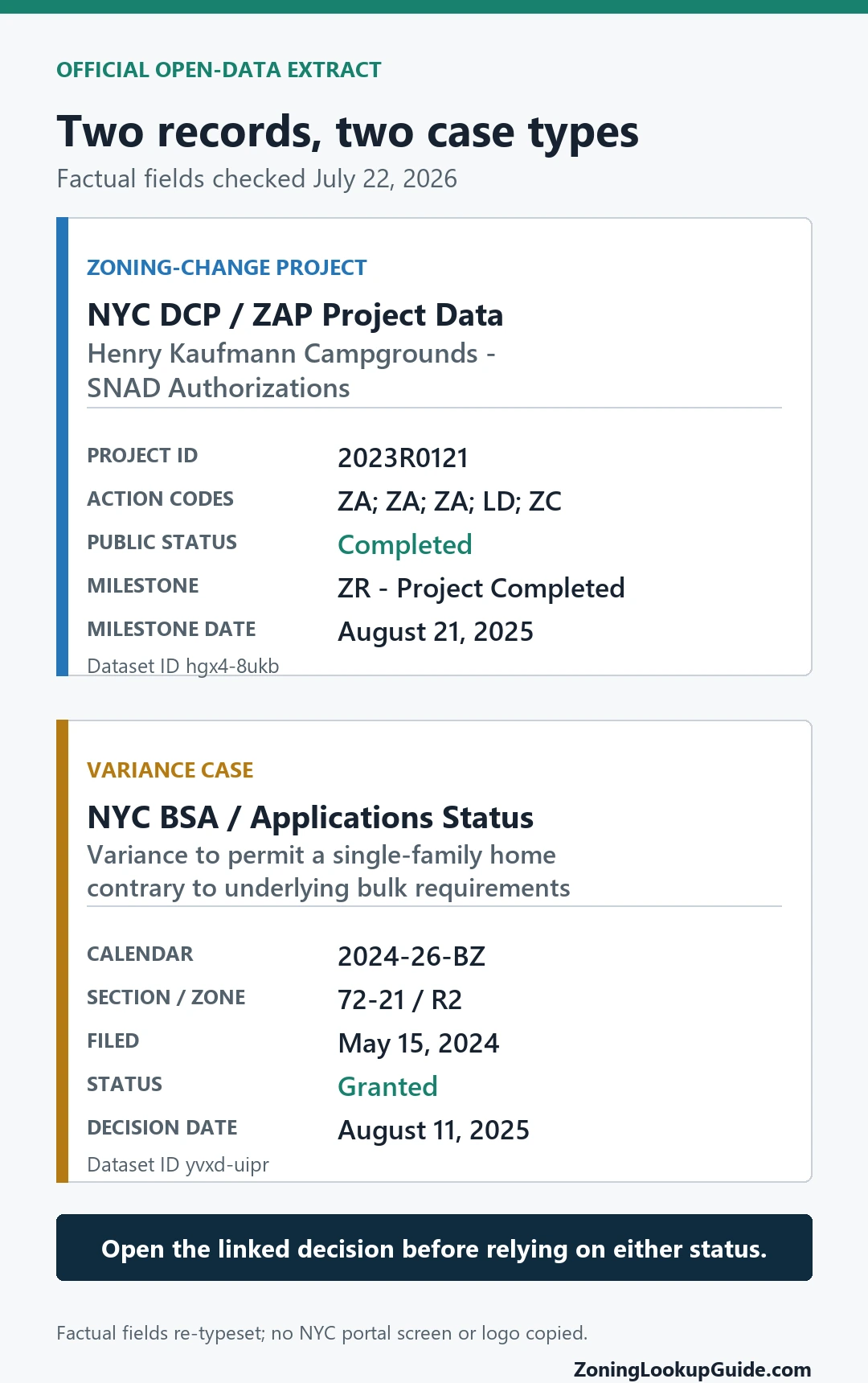
These images use factual fields from open datasets, not copyrighted portal screenshots. NYC’s Open Data public policy says datasets must be available without license or usage restrictions, subject to the stated terms and source-identification requirements.
Open the decision before relying on the result
The signed resolution, ordinance, determination letter, or order is usually the controlling record. Read beyond the first page and capture the exact language that connects the decision to the parcel and proposal.
- Relief granted or map and text change adopted
- Parcel, legal description, and approved plans
- Operating, construction, landscaping, access, or reporting conditions
- Decision date, appeal deadline, and effective date
- Expiration, renewal, revocation, or transfer language
- Later amendments, related cases, permits, and enforcement records
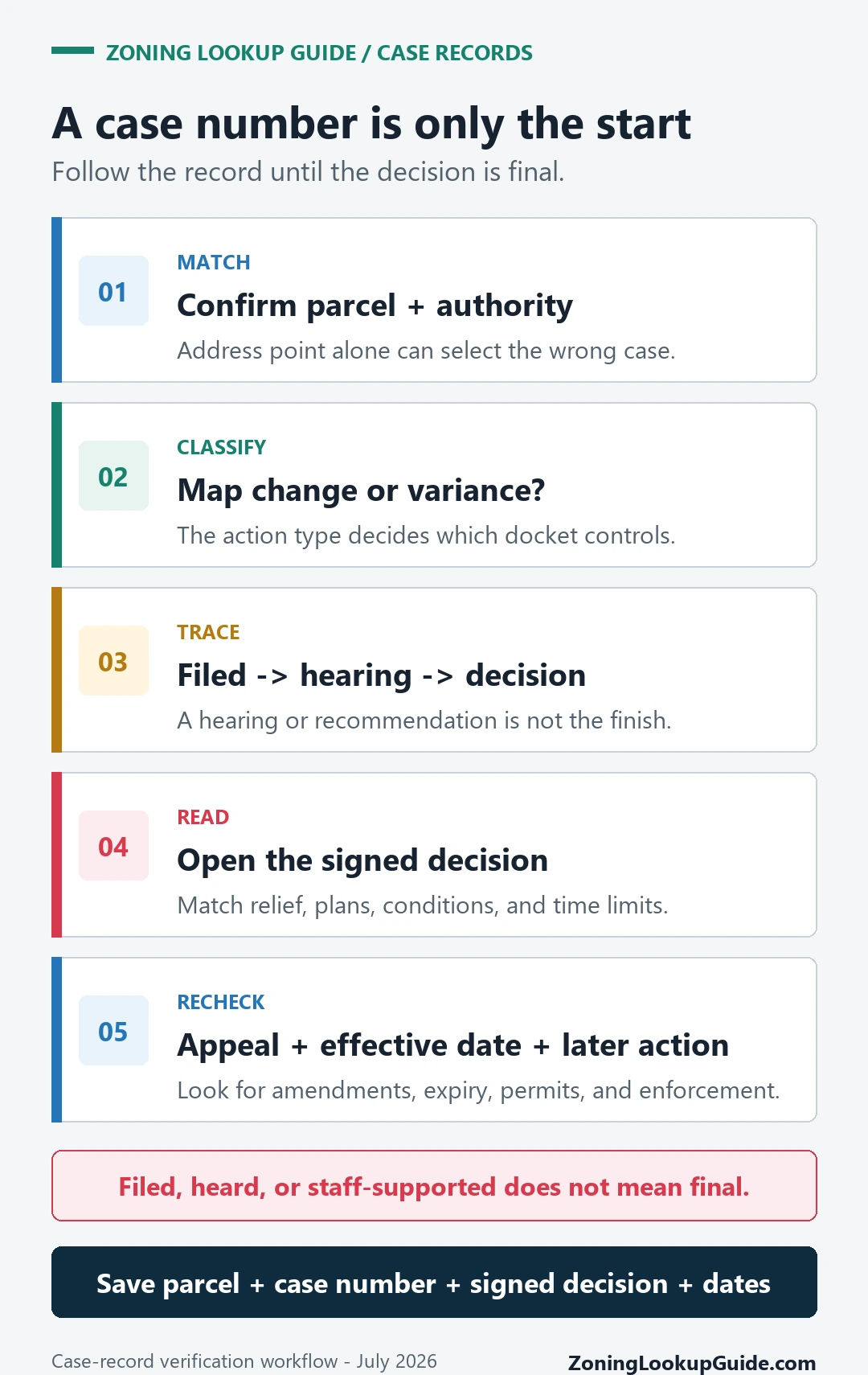
An approval tied to one plan or use does not automatically authorize a different project. It also does not prove that a building permit, certificate, business license, or other required approval was issued.
Save a record that can be checked again
- Authority name and official portal URL
- Address plus parcel, block and lot, or assessor identifier
- Case number and requested action
- Current status and the date the portal was checked
- Decision, conditions, appeal, and effective dates
- Direct links or downloaded copies of the signed documents
Use filenames that include the case number and document date. If a purchase, lease, financing decision, or project schedule depends on the result, recheck the live docket shortly before committing money.
What this record check does not prove
A found case does not prove the parcel is currently compliant, every condition has been satisfied, a permit remains active, or the same relief applies to a new use. It also cannot replace a zoning verification letter, written agency interpretation, title review, survey, or professional advice when one of those is required.
Check the separate zoning violations versus code enforcement guide when the question is compliance rather than entitlement history.
When the portal is incomplete or records conflict
Contact the planning clerk, zoning administrator, board secretary, or records office with the parcel and case number. Ask whether the online docket is complete, whether an appeal or amendment exists, and which document controls. For a consequential decision, request the full case file or a written response rather than relying on an absent search result.
Continue with the neighboring records
- Planning department permit and zoning search
- Chicago zoning map by address
- Zoning violations versus code enforcement
Sources checked July 22, 2026: USA.gov local-government routing, NYC Planning application guidance and ZAP search, NYC BSA rules and applications data, NYC Open Data ZAP Project Data and public policy, and Los Angeles City Planning case search. Local records can change; verify the live case and controlling documents for the parcel.